In the world of table tennis, the rubber is one of the most decisive factors in a player’s performance. Among the many rubbers available, DHS’s Hurricane series has long held a revered status, and in particular Hurricane 3 has become a gold standard for forehand rubber among many Chinese players and serious enthusiasts. Let’s take a deep dive into what makes Hurricane 3 so special, what versions are available, how it plays, and what trade-offs one should be aware of.
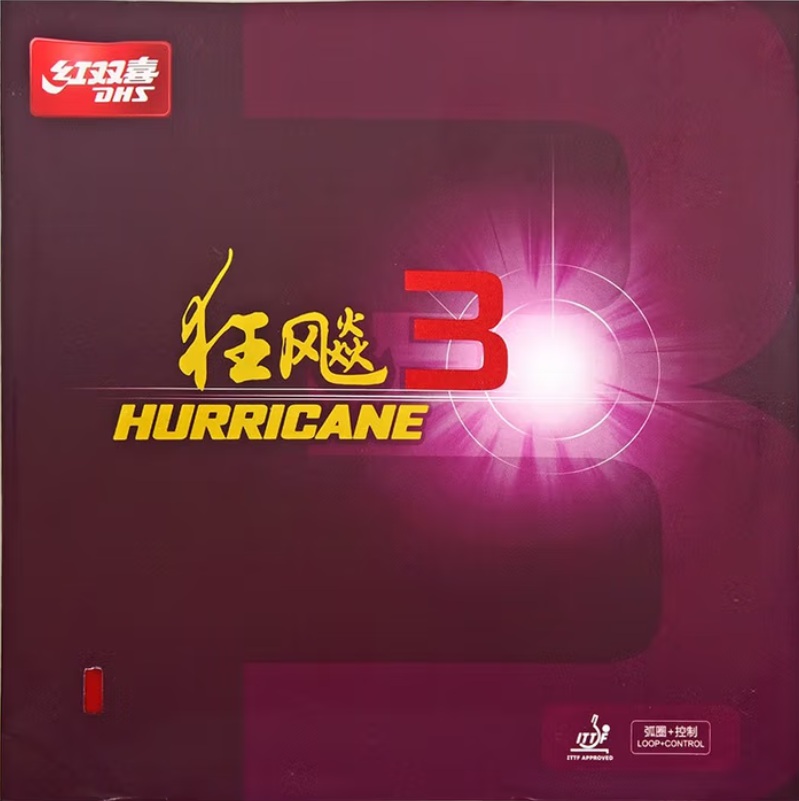
Buy Hurricane 3 rubber from Amazon
What Makes Hurricane 3 Stand Out
Superior Control & Linear Feel
One of Hurricane 3’s most often praised attributes is its exceptional control, especially in short-ball exchanges, pushes, and third-ball openings. Its tacky topsheet, combined with a firm but responsive sponge, allows precise placement with less worry about “jumping up” or drifting. Many users report that the degree of force you apply correlates cleanly with how far the ball travels, giving the rubber a highly linear, predictable feel.
In other words, it rewards consistency: well-timed strokes fly, mis-timed ones may fail. Some reviewers find it less forgiving than European/hybrid rubbers in this regard.
Strong Spin Generation
As a classic “sticky” Chinese rubber, Hurricane 3 excels in generating heavy spin. Whether doing a brush loop, a slow spinny flip, or a fast ripping attack, it can “grab” underspin firmly and translate it into strong topspin. This spin response is a primary reason many loopers choose it as their forehand rubber.
Sturdy Support and “Bottom Force”
Once properly conditioned (for example, via light boosting or oiling), Hurricane 3’s sponge can offer excellent support and “bottom force” — meaning it gives a solid foundation when executing powerful loops or mid/long-distance exchanges. Even when attacked, many users feel confident that the rubber resists “caving in” or losing its structure.
Integrated Feel and Compatibility
A hallmark of a well-designed Chinese rubber is that it does not feel “layered” or disconnected from the blade. Players often report that whether Hurricane 3 is paired with a pure wood blade or a composite blade, the rubber, sponge, and blade “feel like one unit.” That well-blended, consistent feedback makes for more intuitive stroke control. Some rubber-blade combinations may slightly reduce transmission speed or “transparency,” but the core advantages tend to remain.
Durability & Cost Efficiency
In terms of durability, Hurricane 3 is relatively resilient. The sponge retains its elasticity over long use, and the tacky topsheet—even if it gradually oxidizes—does not immediately cripple the rubber’s usefulness. It resists edge chipping and glue shrinkage better than some softer or more delicate rubbers. Because its base version is comparatively affordable, many players feel less pain when replacing it.
Versions & Variants of Hurricane 3
Over time, DHS has released multiple versions of the Hurricane 3 line, each with different characteristics. Here are the key variants:
Ordinary Hurricane 3: The version most widely available. Designed for serious amateurs, it offers a balanced mix of spin, control, and cost. It may require boosting (oiling) to reach its full potential.
Provincial: A higher-grade version reserved for provincial teams. It is often more responsive (softer or more lively) and has better transparency, sponge quality, and consistency.
National: The version reserved (nominally) for national team use. It can offer the highest performance ceiling—maximum spin, support, and responsiveness.
NEO versions: To address the contemporary rules (no speed glue / plastic ball era), DHS introduced Hurricane 3 NEO (and provincial NEO variants). The NEO sponge is engineered to “lock in energy” and facilitate more power and speed while preserving the tacky grip. Players often find that NEO allows more explosive loops or easier energy release without relying as heavily on external boosting.
Additionally, Hurricane 3 comes in varying sponge thicknesses (e.g. 2.10, 2.15, 2.20 mm) and hardness levels. A thinner sheet (2.10 or 2.15 mm) is often recommended for better control, lighter weight, and quicker transitions between forehand and backhand (as many Chinese pros do).
The rubber also has color variants in sponge (e.g. orange sponge, blue sponge). Some players prefer the “blue sponge” models for their firmer feel and greater structural support, though they are often more expensive and limited in color (e.g. only black rubber). Orange sponge tends to offer slightly more “give” and compatibility across a greater number of blade types.
Playing Style Best Suited to Hurricane 3
Given its strengths, Hurricane 3 is especially well-suited to a control + loop (spin-dominant) style of play:
- Short Game & Serve/Receive: It thrives in the short game—serves, pushes, flicks—where its grip and control shine, allowing you to place low, spinny serves and manage delicate touches. Many testers consider it one of the best rubbers for offensive short exchanges.
- Looping & Spin Drives: In mid and long distance exchanges, Hurricane 3’s spin potential and support encourage strong looping, especially when executed with a full brush. Its “bottom force” helps it withstand follow-throughs and maintain trajectory.
- Counterlooping & Overriding Spin: One of the unique advantages of sticky rubbers is how well they can “grab” incoming spin and reimpose your own spin. Hurricane 3 does this particularly well, making it excellent for counterlooping against aggressive spin.
- Adapting to 40+ (Plastic) Balls: In the era of larger, less spin-friendly plastic (40 mm+) balls, Hurricane 3’s strong grip helps compensate for lost spin. It also helps mitigate the “heaviness” of the ball when controlled. Many users find it easier to maintain spin depth and control under the constraints imposed by modern balls.
Challenges & Considerations
While Hurricane 3 is powerful, it is not without trade-offs. Here are its commonly noted drawbacks and how to manage them:
High Skill Demand (Low Margin for Error)
Because the rubber is quite “tight” and demands precise timing, slight errors in technique—or hitting the ball off-center—can lead to misses or weaker strokes. As one player put it, Hurricane 3 “is an extremely low fault tolerance rubber: it gives excellent output when you hit properly, but punishes mis-hits more harshly.”
Thus, it’s often less forgiving than European rubbers, making it more suited to intermediate/advanced players than absolute beginners.
Lower Speed on Flat Strikes
Hurricane 3 is not optimized for raw smash power or high-speed flat drives. The tacky top slows the initial exit velocity compared to more elastic “catapult” rubbers. Many users feel it has a “slower” or “heavier” feel in non-looping strokes.
Maintenance & Boosting Complexity
To reach peak performance, many players boost (oil) or treat the sponge, which is a time-consuming, sometimes messy process. The difference between a non-treated and well-treated Hurricane 3 can be dramatic. Some users adopt a hybrid approach—boost once after first mounting, and refresh later only when necessary.
Also, non-boosted versions (especially in the NEO line) sometimes struggle to “activate” fully out of the box, so patience or initial tuning is often required.
Durability under Heavy Use
There is some discussion in forums about durability, especially for the NEO/base versions. For example, some players report oxidation or loss of tackiness after a few months of intensive play, manifesting as shiny spots or reduced spin.
Summary & Recommendation
The DHS Hurricane 3 is a legendary, time-tested rubber that combines exceptional spin, control, and a uniquely integrated feel. Its greatest strengths lie in the short game, spinning loops, and in contexts where precision and consistency matter—especially in the modern plastic‐ball era where every bit of grip and spin counts.
However, it is also a demanding rubber: it rewards technique, punishes sloppiness, and often requires careful maintenance or tuning. It is best suited for intermediate to advanced players willing to invest in mastering its nuances.
If you are considering trying Hurricane 3, here are a few suggestions:
- Start with the base version to experience its character before attempting provincial or national grades.
- Consider using a thinner version (2.10 or 2.15 mm) for better control and quicker transitions.
- Pair it with a compatible blade (ideally balanced or somewhat soft) to maximize the integrated feel.
- Be prepared to spend time tuning or boosting, and treat the rubber with care (cleaning, proper glue, avoiding extreme exposure).
- If your technique or timing is still developing, consider a more forgiving rubber until you can consistently hit cleanly.