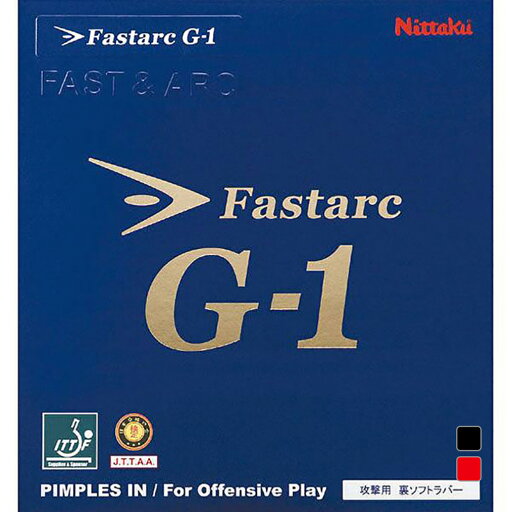
The Nittaku Fastarc G-1 is widely regarded as a legendary offensive table tennis rubber, maintaining its status as one of the world’s most popular choices for over a decade. Developed as a collaboration between Japanese design and German manufacturing (ESN), it serves as the flagship “Grip First” model in Nittaku’s Fastarc series. For three consecutive years between 2019 and 2021, it was the top-selling rubber on major retail platforms and remains the best-selling rubber in Asia. Its reputation is built on an exceptional balance of speed, spin, and predictability, making it a primary alternative to high-end series like Butterfly’s Tenergy at a significantly more accessible price point.
Buy Nittaku Fastarc G-1 from Amazon
Technical Specifications and Construction
The G-1 features a 47.5-degree orange sponge, classifying it as a medium-hard rubber. The sponge is coarse-pored and highly tensioned, which contributes to its “linear catapult” effect. Its “Grip-type” topsheet is designed with wide pips and narrow pip spacing (13 pips per 5 cm horizontally), optimized to maximize mechanical grip. While some users describe the surface as having a slight tackiness similar to Tibhar MX-P or Rakza 7, it primarily relies on its extreme grip and elasticity rather than stickiness to generate rotation.
Weight-wise, the G-1 is often considered medium-heavy. When cut to a standard 157x150 mm blade, a 2.0mm sheet typically weighs approximately 49 to 50 grams. Notably, Nittaku’s thickness labeling differs from other brands; the 2.0mm version is marketed as “Super Thick,” while the “MAX” version is roughly equivalent to a standard 2.0mm or 2.1mm sponge from other manufacturers.
The “Breaking-In” Period
A critical aspect for new users to understand is that the G-1 often requires a “break-in” period of roughly 10 hours. Out of the package, the rubber can feel stiff, stubborn, and even “dead,” leading some players to initially find it difficult to control or slow. However, after the initial hours of play, the sponge and topsheet soften slightly, revealing the rubber’s true dynamic range and elastic power.
Speed and The Linear Catapult
The G-1 is not the absolute fastest “rocket” tensor on the market when compared to rubbers like Tibhar Evolution MX-P. Instead, it is defined by its linear response, meaning the speed generated is directly proportional to the force the player applies.
- Passive Play: In passive blocks or short touches, the rubber remains relatively tame, which prevents the ball from bouncing uncontrollably off the bat.
- Active Play: When the player engages the sponge with a full swing, the rubber “comes alive,” offering formidable power and many gears. This predictability makes it an “extremely honest” rubber that accurately reflects the quality of the player’s technique.
Spin and Trajectory (The “Arc”)
As the name suggests, the Fastarc G-1 is designed to produce a high, safe arc. It features a medium-high to high throw angle, providing significant clearance over the net. This high arc is a double-edged sword: it offers immense safety during heavy topspin rallies but can lead players with poor technique to overshoot the table if they hit too vertically.
The spin potential of the G-1 is its greatest weapon. The grippy topsheet allows for extreme rotation on opening loops and thin brush shots. It is particularly effective for:
- Lifting Underspin: Its high grip and throw make it one of the best rubbers for attacking heavy backspin, even if the ball is caught late or low.
- Counter-topspinning: The rubber’s stability allows players to aggressively counter-loop against an opponent’s spin with high confidence.
Offensive Performance: Looping and Driving
The G-1 is primarily a looper’s rubber. To maximize its potential, players are encouraged to use a forward-leaning motion and a closed racket angle. Because the topsheet is stiff, it requires active engagement; “lazy” players who do not use proper legwork and hip rotation may find the rubber feels “dead” or lacks spin. However, for technically sound players, it provides the stability and bite needed for consistent, heavy topspin rallies from mid-to-far distance. It is also noted for being less sensitive to incoming spin than many other high-performance tensors, which helps in maintaining accuracy under pressure.
Defensive and Short Game Characteristics
Despite its offensive focus, the G-1 is highly competent in the short game due to its low catapult at low speeds.
- Blocking: It is described as a “beast” for blocking. The firmness of the topsheet helps neutralize the opponent’s spin, allowing for crisp, direct, and aggressive blocks.
- Serves and Pushes: The high grip allows for wickedly spinny serves. Pushes can be kept low and short, though the high throw angle requires the player to be careful not to let the ball pop up high.
- Chopping: While primarily an offensive rubber, some modern defenders use it for heavy backspin chops, though it requires a low contact point to prevent the ball from soaring long.
Durability and Value
One of the most praised features of the Fastarc G-1 is its outstanding durability. Many high-performance rubbers, such as Tibhar MX-P, may lose their peak performance after 6 weeks; in contrast, the G-1 is reported to remain in excellent condition for 6 to 12 months of regular use. The topsheet is remarkably resilient and maintains its grip levels even as it wears. This longevity, combined with a price point roughly 30-50% lower than the Tenergy or Dignics lines, makes it arguably the best value-for-money offensive rubber on the market.
Suitability and Pairings
- Player Level: While some recommend it for beginners due to its consistency, most experts suggest it for intermediate to professional players. Beginners may struggle with its weight and the requirement for active technique.
- Blade Pairings: It harmonizes exceptionally well with all-wood blades (like the Stiga Clipper or Nittaku Acoustic) for a more controlled feel, or inner-carbon blades for a balanced offensive setup. It can feel overly stiff or “plastic-like” on very hard carbon blades with outer koto layers.
- FH vs BH: Most users prefer it as a forehand (FH) rubber due to its hardness and spin potential. However, it is also a popular backhand (BH) choice for players with an active, aggressive backhand style who can handle the higher throw.
Potential Drawbacks
- Weight: Its mass can make a racket feel head-heavy, which may be a disadvantage for some.
- Sponge Sensitivity: The sponge is delicate when removing glue; players must be careful to avoid creating “craters” in the sponge during re-gluing.
- Humidity: The topsheet has been noted to collect moisture in humid conditions more than some other rubbers, requiring it to be dried during play to maintain grip.
- Overshooting: The high arc can be unforgiving for players who hit “flat” or use a very vertical stroke, leading to many balls landing just past the table edge.
Summary of the Fastarc Series Comparisons
Within the Nittaku family, the G-1 is the hardest and spinniest.
- C-1: Features the same topsheet as G-1 but with a softer (43°) sponge, offering a more “mushy” feel and more catapult for those who find the G-1 too demanding.
- P-1: Designed for the plastic ball with a different topsheet that emphasizes speed and a softer feel in gameplay, though often considered less spinny than G-1.
- S-1: The “Speed First” version with a 45° sponge and a different pip architecture, resulting in the lowest arc and least spin of the series.
Conclusion
The Nittaku Fastarc G-1 is a stable, high-performance masterpiece. It offers a “linear” power that rewards good technique with devastating spin and safe, high-arcing trajectories. Its world-class durability and reasonable price have cemented its place as a staple for offensive players who want the performance of a professional tensor without the inconsistency or high replacement costs of its competitors. Whether used for a heavy 3rd-ball attack or a consistent looping game, the G-1 remains an “end-game” rubber for the serious table tennis athlete.