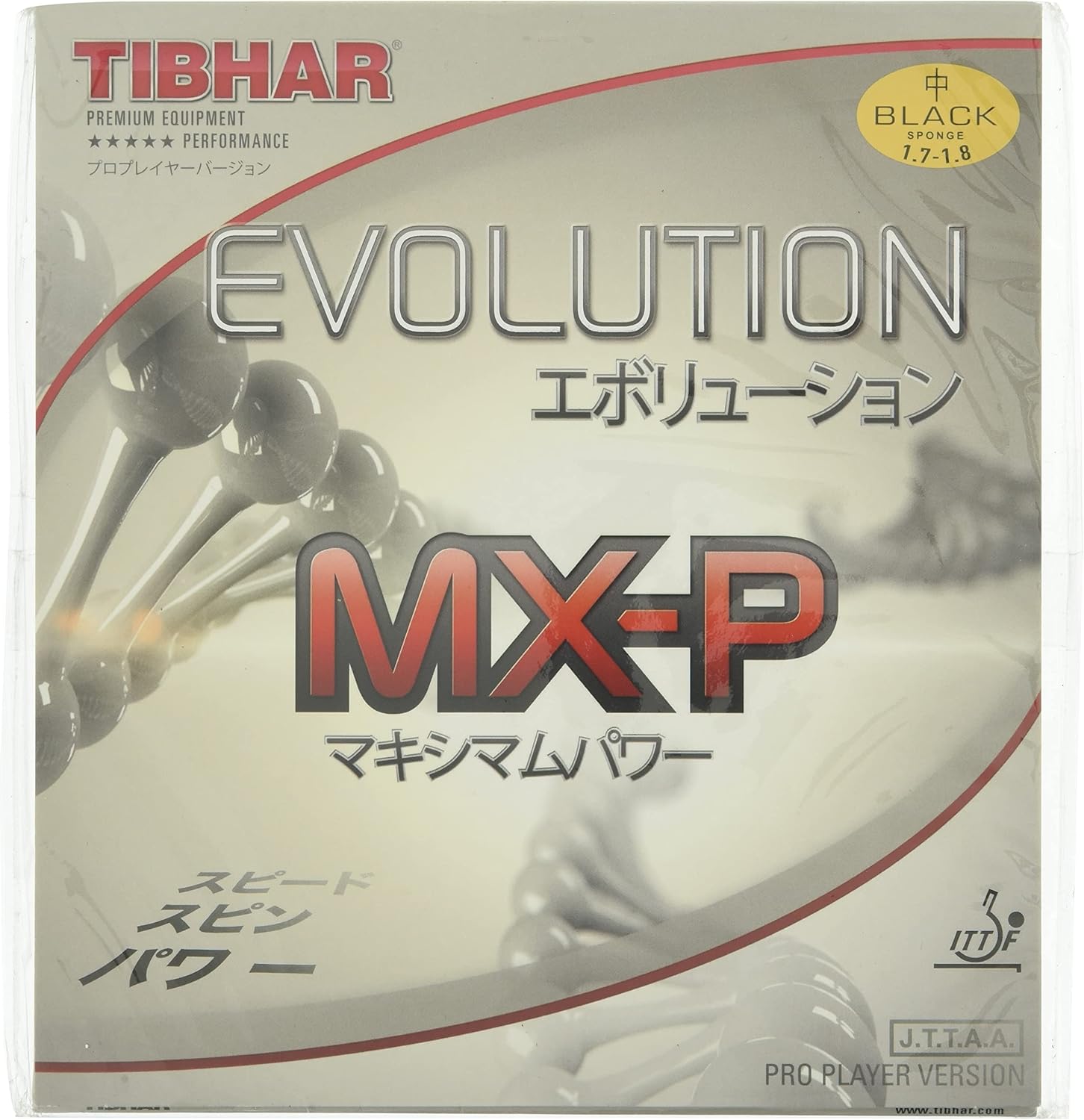
The Tibhar Evolution MX-P has established itself as a legendary fixture in the table tennis world since its debut in 2011. Often hailed as the ultimate challenger to the dominance of the Tenergy series, it has become one of the most widely used and discussed rubbers globally. This review explores why this German-made powerhouse remains a top choice for aggressive offensive players over a decade after its release.
Buy Tibhar Evolution MX-P from Amazon
Technical Specifications and First Impressions
The MX-P is the fastest and most dynamic member of the Evolution family. It features Tibhar’s signature “Red Power Sponge,” a bright red, large-pored sponge that provides a significant catapult effect. The topsheet uses “ProTension” technology, resulting in a glossy surface that possesses a slight hint of tackiness, which aids in ball-grabbing during high-friction strokes.
In terms of physical attributes, the MX-P is a relatively heavy rubber. An uncut sheet typically weighs around 72 to 73 grams, which drops to approximately 49 grams once cut to a standard blade. This weight contributes to a solid, stable feel but may require players to consider the overall balance of their racket. The sponge hardness is rated at approximately 46.7° to 47.7° (EUR scale), placing it firmly in the medium-hard category. Upon opening the package, players often notice a distinct, sweet booster smell, though the rubber does not dome significantly.
Speed and The “Alive” Feeling
The defining characteristic of the MX-P is its explosive speed. It is an uncompromising offensive tool designed for players who want to finish rallies with authority. During play, the rubber feels “alive,” offering a loud, satisfying clicking sound that instills confidence during hard-driving strokes.
The catapult effect is pronounced, making it easy to generate massive power with minimal effort. While many high-tension rubbers can feel uncontrollable, the MX-P is often described as being more direct and responsive than its Japanese competitors. This directness allows for a super-fast game near the table, but the rubber also has enough power reserves to engage in topspin-to-topspin duels from mid-distance.
Spin Capability and Service Game
Despite its primary reputation for speed, the MX-P is a spin monster in the right hands. It provides excellent traction, allowing players to generate heavy rotation on serves and opening loops. Professional players like Vladimir Samsonov and Paul Drinkhall have utilized this high spin-to-speed ratio to maintain a world-class offensive game.
For serves, the MX-P allows for a high degree of deceptiveness. It is easy to keep the ball low and short while imparting heavy backspin. When the sponge is fully engaged during a loop, the spin levels are equal to the best offensive rubbers on the market. However, unlike softer rubbers that generate spin through easy deformation, the MX-P rewards a clean, technical stroke and high racket speed.
The Short Game and Blocking
One of the most surprising aspects of the MX-P is its performance in the short game. Often, fast rubbers suffer from excessive bounciness, making pushes and serve returns difficult. The MX-P, however, is relatively spin-insensitive during passive play. The catapult does not usually kick in on low-energy shots, allowing for short, low pushes that are difficult for opponents to attack.
Blocking with the MX-P is direct and efficient. The sponge does an admirable job of absorbing the kinetic energy of incoming loops, allowing for precise redirection. Because of its harder sponge, blocks tend to be very fast and can often catch opponents off-guard due to the ball’s flat trajectory.
Looping and Counter-Looping
The MX-P is a dream for power-loopers. The throw angle is medium to low, which creates a very direct and dangerous arc. While this makes it a bit more challenging to lift heavy backspin compared to a high-throw rubber like Tenergy 05, it provides a much more lethal finishing shot once the rally is opened.
In counter-looping situations, the MX-P is a force to be reckoned with. It has the ability to take the energy of an opponent’s attack and return it with even greater force. For players who prefer a “hit-through-the-spin” style of play, this rubber is perfectly suited.
Real-World Durability and Sensitivity
A common point of discussion in the table tennis community is the durability of the MX-P. Some users have noted that the rubber’s peak performance—its “fresh” feeling—can begin to fade after about a month of heavy use. After three months, the topsheet may lose its grip, essentially turning the rubber into a less effective version of itself.
Another unique quirk is its sensitivity to moisture. In humid environments, even a tiny amount of moisture on the topsheet can cause the ball to slip significantly, which can be frustrating during competitive matches. Additionally, the sponge can be somewhat fragile; users have reported bits of the red sponge getting ripped apart when peeling off old glue, so care is needed during maintenance.
Blade Pairings and Recommendations
The MX-P is a versatile rubber that pairs well with a wide range of offensive blades. Popular combinations include:
- Butterfly Viscaria/Timo Boll ALC: The Koto outer plies combined with the Arylate-Carbon layer provide a balance of dwell time and speed that complements the MX-P’s directness.
- Tibhar Samsonov Force Pro: A classic 7-ply all-wood blade that offers a more natural feel for aggressive topspin games.
- Outer Carbon Blades: Blades like the Zhang Jike ZLC are often recommended to maximize the rubber’s explosive potential.
While it is a magnificent rubber, it is not recommended for beginners. The high speed and lack of a large “forgiveness factor” mean that players without years of practice may struggle with consistency and make many unforced errors. It is best suited for advanced-to-professional players who possess good touch and a high technical level.
MX-P vs. Tenergy 05
The comparison between MX-P and Tenergy 05 is inevitable. Many players find that:
- Speed: MX-P is generally faster and harder than Tenergy 05.
- Throw Angle: Tenergy 05 has a higher arc, making it safer for pure looping, while MX-P is more direct and better for smashing and flat hitting.
- Short Game: MX-P offers better consistency and control in the short game for many players.
- Value: MX-P is often significantly more affordable, frequently found in “buy 4, pay 3” deals that make it half the price of its Japanese rival.
The Evolution of the Series: MX-P50
In recent years, Tibhar introduced the MX-P50, a version with a harder 50-degree sponge designed to compensate for the reduced spin and speed of the plastic ball. This version is even more uncompromising, offering pinpoint accuracy for those who can handle its brute hardness, but it is even less forgiving than the original.
Final Verdict
The Tibhar Evolution MX-P is a masterpiece of ESN rubber engineering. It successfully blends the characteristics of European/Japanese tension rubbers with a directness that appeals to aggressive attackers. While it has its flaws—notably its sensitivity to humidity and potentially shorter lifespan—its performance-to-price ratio remains one of the best in the industry.
Buy Tibhar Evolution MX-P from Amazon
If you are a high-level offensive player looking for a rubber that produces deadly speed, heavy spin, and a crisp feel, the MX-P is still the gold standard in the Evolution series. It rewards active, aggressive play and provides the “powerwood” feel that has made it a bestseller for over a decade. For those moving away from Tenergy, it is undoubtedly the most seamless and rewarding transition you can make.